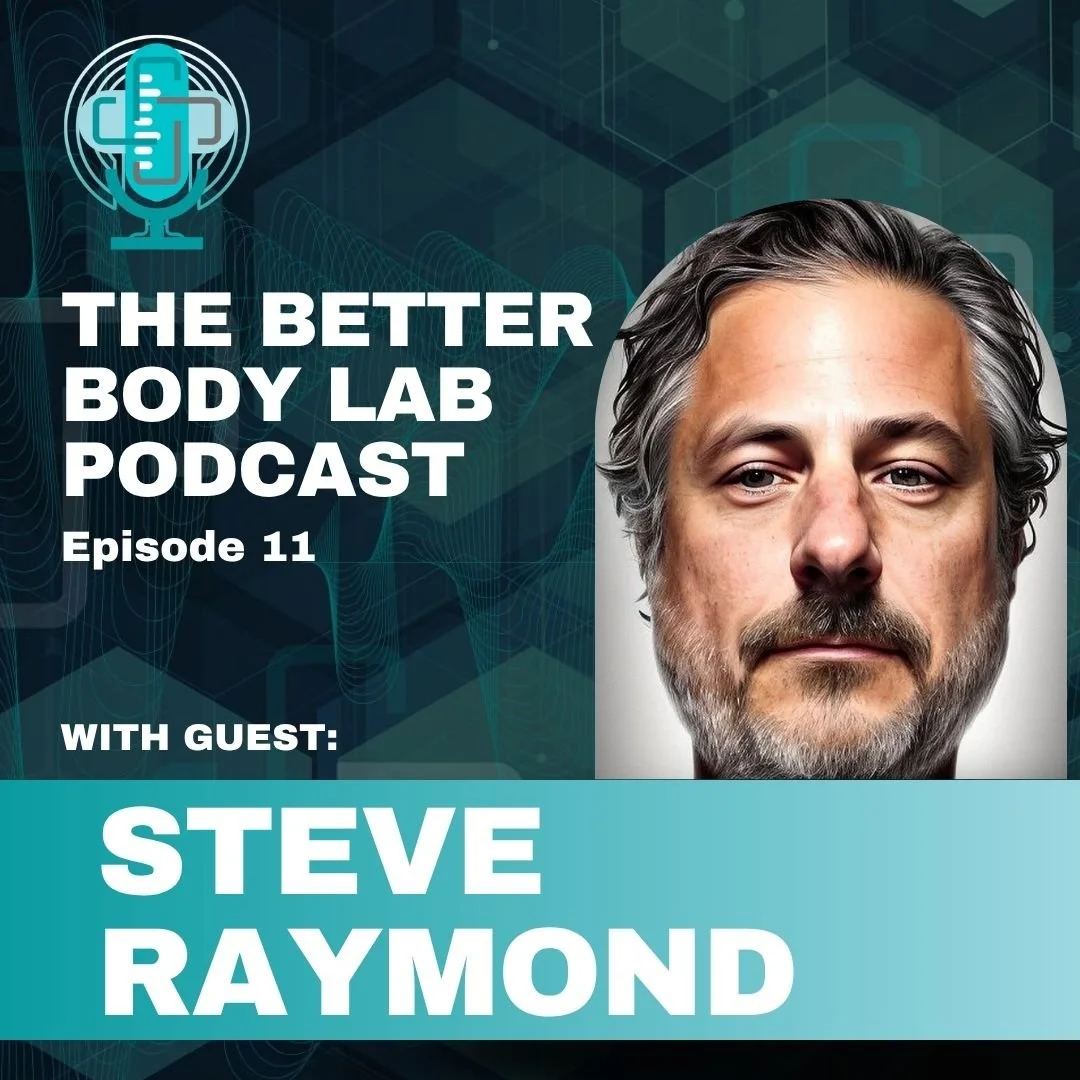
Steve Raymond
AI Could Redefine Body Composition Measurement
What if the future of health optimization isn’t just about losing weight — but understanding what your body is actually made of? In this episode of The Better Body Lab Podcast, we explore how AI, computer vision, and smartphone technology may fundamentally reshape the way we measure metabolic health, recovery, longevity, and human performance. Together, we sit down with Prism Labs CEO and co-founder Steve Raymond to examine why traditional tools like BMI often fail individuals — and why body composition, lean muscle mass, and visceral fat may offer a far more meaningful picture of long-term wellbeing.
Together, we explore how science, technology, and lived experience intersect within the human ecology of health — the dynamic relationship between physiology, environment, behavior, and performance. Steve explains how Prism Labs uses AI-powered computer vision and smartphone video scans to estimate body fat percentage, lean muscle mass, metabolic age, and visceral fat from a simple 30-second scan performed at home. Rather than focusing solely on scale weight, this technology aims to help individuals better understand the deeper physiological changes happening beneath the surface.
Our conversation dives into the limitations of BMI, the strengths and weaknesses of Dexa scans and bioimpedance devices, and why consistency and trend-tracking matter more than obsessing over a single “perfect” measurement. We also examine how lean muscle preservation impacts metabolic resilience, especially for individuals using GLP-1 medications, and why visceral fat remains one of the most important — yet often overlooked — health markers.
Beyond the technology itself, this episode becomes a broader discussion about personalization, awareness, and sustainable behavior change. We explore how AI-driven wellness tools may improve accessibility to advanced health insights while also raising important conversations around privacy, data ownership, and responsible innovation.
Episode Overview
Steve shares his unconventional journey from nuclear engineering and digital media into computer vision, AI, and personalized wellness technology. Drawing from decades of experience building companies at the intersection of media, technology, and consumer behavior, he explains how Prism Labs evolved into a platform now powering body composition experiences for brands including Noom, WeightWatchers, Signos, and Novo Nordisk.
Together, we unpack the growing disconnect between traditional weight-centric thinking and modern metabolic science. We discuss why muscular individuals are frequently mislabeled as “obese” under BMI standards, how optical scanning technologies continue to improve, and why future health tracking may rely less on static numbers and more on dynamic biological patterns.
This conversation reinforces a powerful idea: resilience and performance are not simply about weight loss — they are about preserving strength, metabolic flexibility, recovery capacity, and long-term vitality.
What You’ll Learn in This Episode
• Why BMI often fails to accurately reflect individual health and body composition
• How smartphone-based AI body scans estimate body fat, lean muscle, and visceral fat
• The differences between Dexa scans, bioimpedance devices, calipers, and optical scanning
• Why visceral fat is strongly linked to metabolic disease and chronic inflammation
• How lean muscle mass impacts longevity, metabolism, recovery, and performance
• Why GLP-1 medications can increase the risk of muscle loss during weight reduction
• How clothing, lighting, and scan consistency affect body composition measurements
• Why trend tracking matters more than chasing a perfectly “accurate” number
• How Prism Labs approaches data privacy, anonymization, and AI model training
• The growing role of computer vision and AI in preventative wellness and health optimization
• Why sustainable health progress often happens even when the scale doesn’t change
• How curiosity, self-awareness, and measurable feedback support long-term resilience
About Our Guest
Steve Raymond is the CEO of Prism Labs, the company turning any smartphone camera into a clinical-grade body composition scanner — measuring the biomarkers that matter most for longevity and health: metabolic age, body fat, lean muscle, and visceral fat. Prism is built as an enabling platform for innovators across longevity, fitness, weight management, and clinical care, and powers experiences for Noom, WeightWatchers, Signos, and Novo Nordisk. The team is now advancing the field with BodyGPT, a foundation model which uses every pixel in a video to push 3D optical scanning to new levels of precision — and was selected as a leading technology for the FNIH-backed REAL BODY study. It's the fifth time in 25 years Steve has jumped into a new technology early and done the work of turning science into product — helping it cross the chasm from early adopters into the mainstream. Earlier chapters: Yahoo! Music, co-founding YouTube-era creator company Big Frame (acquired by DreamWorks), and leading 8i, which pioneered neural networks and computer vision for 3D modeling of the human body. Steve holds an MBA from UCLA Anderson and a BS in Mechanical Engineering from Notre Dame.
For information about Prism Labs visit: www.prismlabs.tech
Follow Prism Labs here:
Instagram: @prismlabs.tech
LinkedIn: https://www.linkedin.com/company/prismlabs-inc/
Follow Steve here:
LinkedIn: https://www.linkedin.com/in/stephenpraymond/